
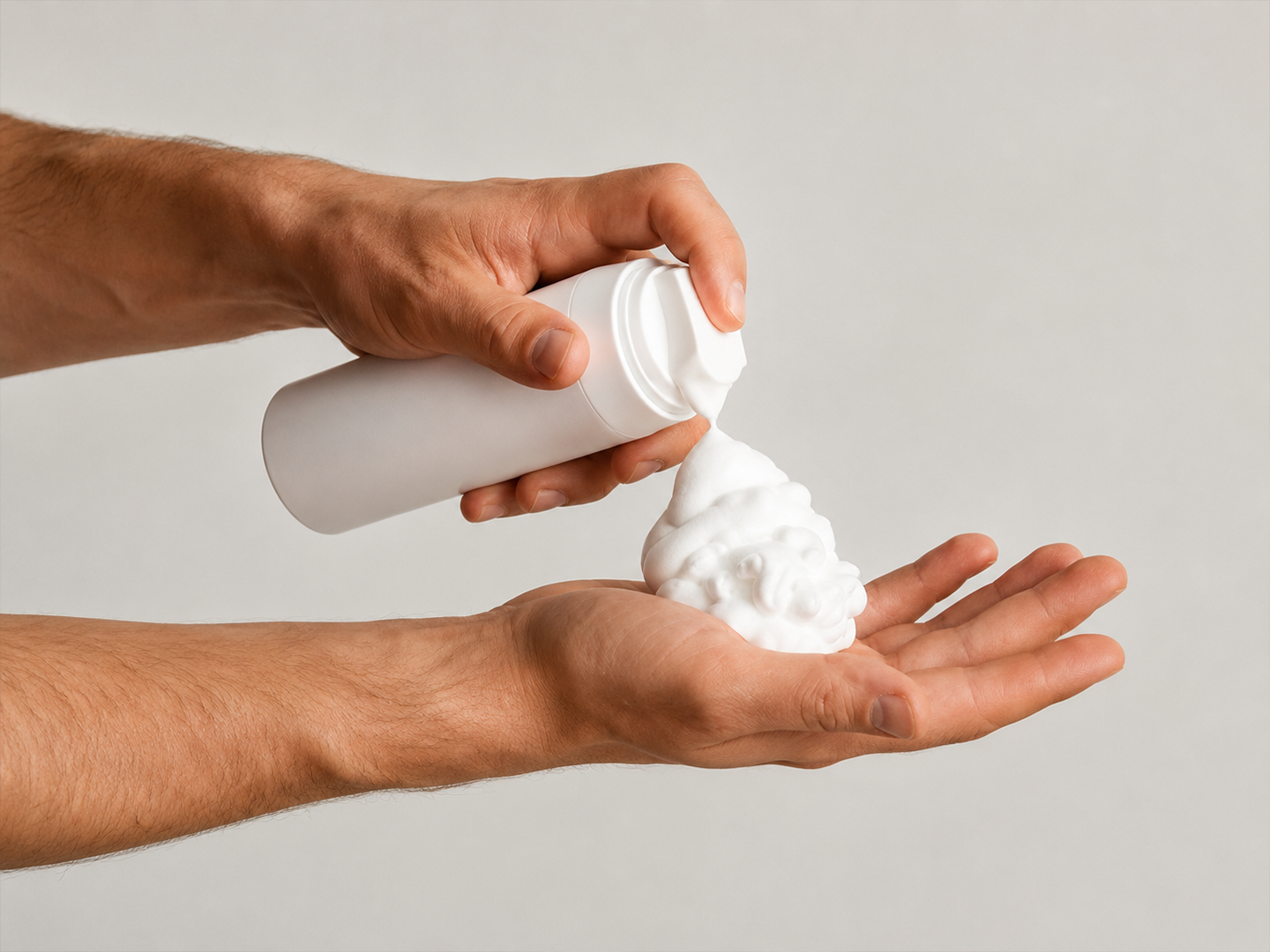
How Does a Foam Pump Work?
When the actuator is pressed, the foam pump draws both liquid and air into separate parts of the mechanism.
These are then mixed and pushed through a mesh or foaming structure.
The result is a pre-formed foam rather than a stream of liquid.
Because the pump relies on the relationship between air and liquid, the formulation needs to be designed for foaming.
A conventional thick lotion normally cannot simply be placed into a foam bottle and expected to work correctly.
Why Does Formulation Matter So Much?
Foam pump performance depends heavily on viscosity.
If the formula is too thick, the pump may struggle to draw and mix the product correctly.
Surfactant composition and concentration also influence foam quality.
For this reason, foam pump testing should always be done using the actual formulation.
Testing only with water gives limited information about real performance.
Common Foam Pump Applications
Foam pumps are often used for:
hand soap, facial cleanser, baby wash, personal hygiene products, pet grooming products and selected household applications.
The main advantage is that the user receives a ready-to-use foam without having to rub the liquid extensively to create lather.
Foam Pump vs Lotion Pump
A lotion pump is designed primarily to dispense liquid or semi-liquid product.
A foam pump creates a mixture of air and liquid.
Therefore, the two dispensing systems are not directly interchangeable.
Even if both pumps fit a similar bottle size, the internal construction and formulation requirements are different.
What Should Buyers Evaluate?
Important factors include:
- foam quality
- dosage
- formulation viscosity
- actuator feel
- bottle compatibility
- neck size
- locking system
- repeated-use performance
When developing foam packaging, the most reliable approach is to test the formula, foam pump and bottle together.