
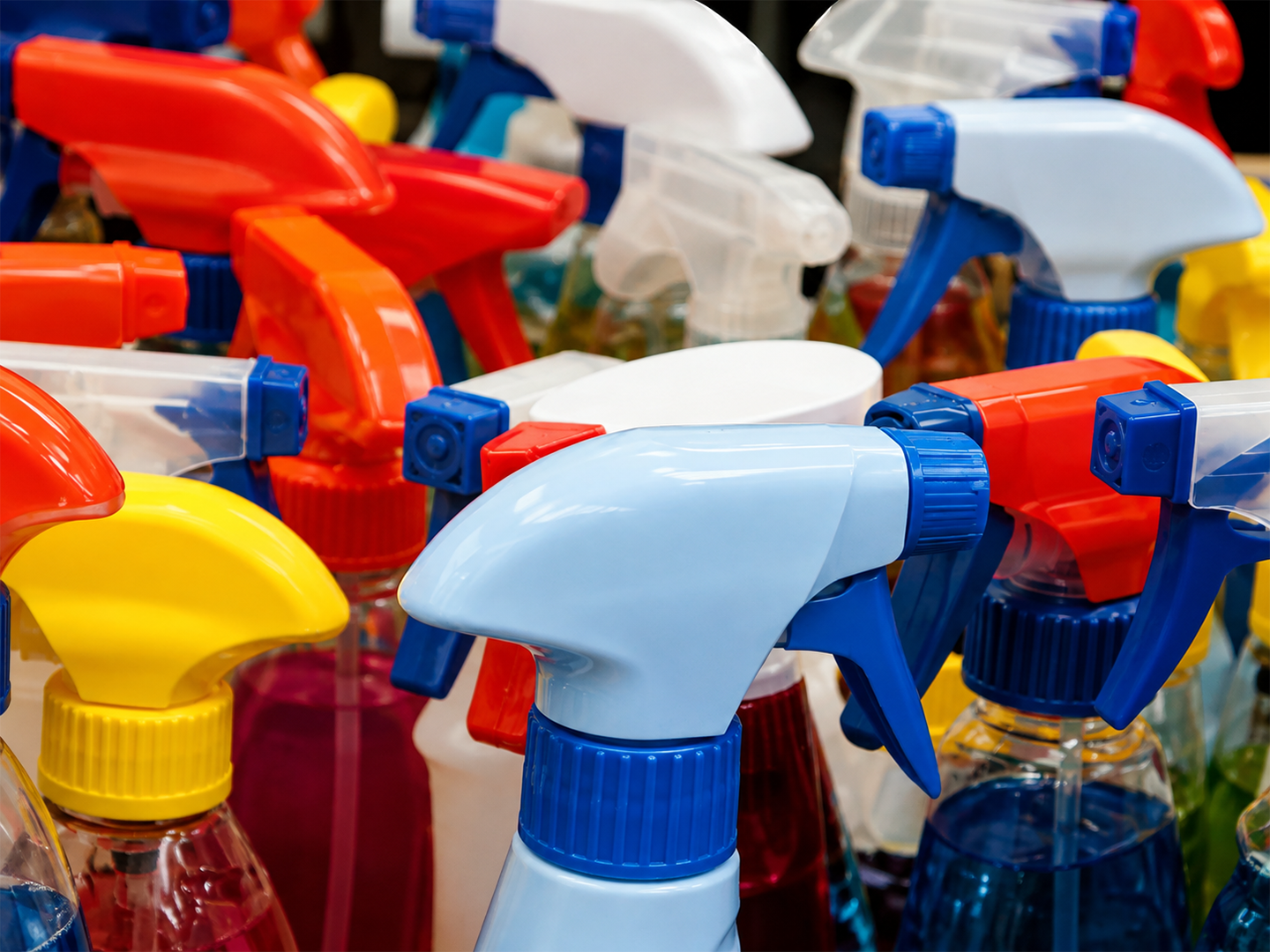
How to Choose the Right Trigger Sprayer
Trigger sprayers can look very similar in a catalog, but their performance can be quite different once they are filled with actual product.
For packaging buyers, choosing the correct trigger sprayer normally starts with the formulation.
Start With the Liquid
The first question should be:
What liquid will be dispensed?
Water-based household cleaners are generally easier to package than products containing aggressive solvents or chemicals.
For more demanding formulations, the materials used inside the trigger sprayer need to be evaluated carefully.
The best approach is to provide the supplier with basic formulation information and then perform compatibility testing using the actual product.
Decide the Required Spray Pattern
Not all trigger sprayers are designed to produce the same spray.
Depending on the nozzle, the user may need:
- mist
- spray
- stream
- adjustable spray/stream
- foam-type output in selected systems
A glass cleaner may benefit from broad surface coverage, while another product may need a concentrated stream.
The nozzle should therefore be selected according to real use rather than appearance.
Compare Trigger Sprayer Output
Output determines how much product is dispensed with every pull.
A higher-output trigger sprayer can cover a large area quickly, but it also consumes more product.
The ideal output depends on bottle capacity, viscosity, application area and consumer expectations.
Confirm Bottle Neck Compatibility
A trigger sprayer must match the bottle neck specification.
Do not rely only on visual similarity.
Neck finish, thread structure and sealing surface all need to correspond correctly.
For a new packaging project, it is often more efficient to confirm the bottle and trigger sprayer together.
Evaluate Ergonomics
Trigger shape matters more than many buyers expect.
If the product will be used repeatedly—such as a household cleaner—the user should be able to operate the sprayer comfortably.
Trigger width, finger space, actuator resistance and bottle grip all contribute to user experience.
Test Leakage and Transportation
A sprayer that performs correctly during laboratory testing also needs to survive transportation.
Carton orientation, vibration, pressure changes and temperature can expose sealing weaknesses that are not obvious during a short bench test.
Before mass production, testing the assembled trigger sprayer and bottle is therefore essential.