
How Does a Trigger Sprayer Work?
When the trigger is pulled, an internal piston moves inside the pump body and creates pressure.
Liquid is drawn from the bottle through the dip tube and pushed through the internal fluid path toward the nozzle.
Depending on the nozzle design, the product may leave the sprayer as a mist, spray, stream or other controlled pattern.
When the trigger is released, the spring and internal mechanism return to their original position, preparing the pump for the next stroke.
This process appears simple from the outside, but reliable trigger sprayer performance depends on the interaction between several components.
What Are the Main Parts of a Trigger Sprayer?
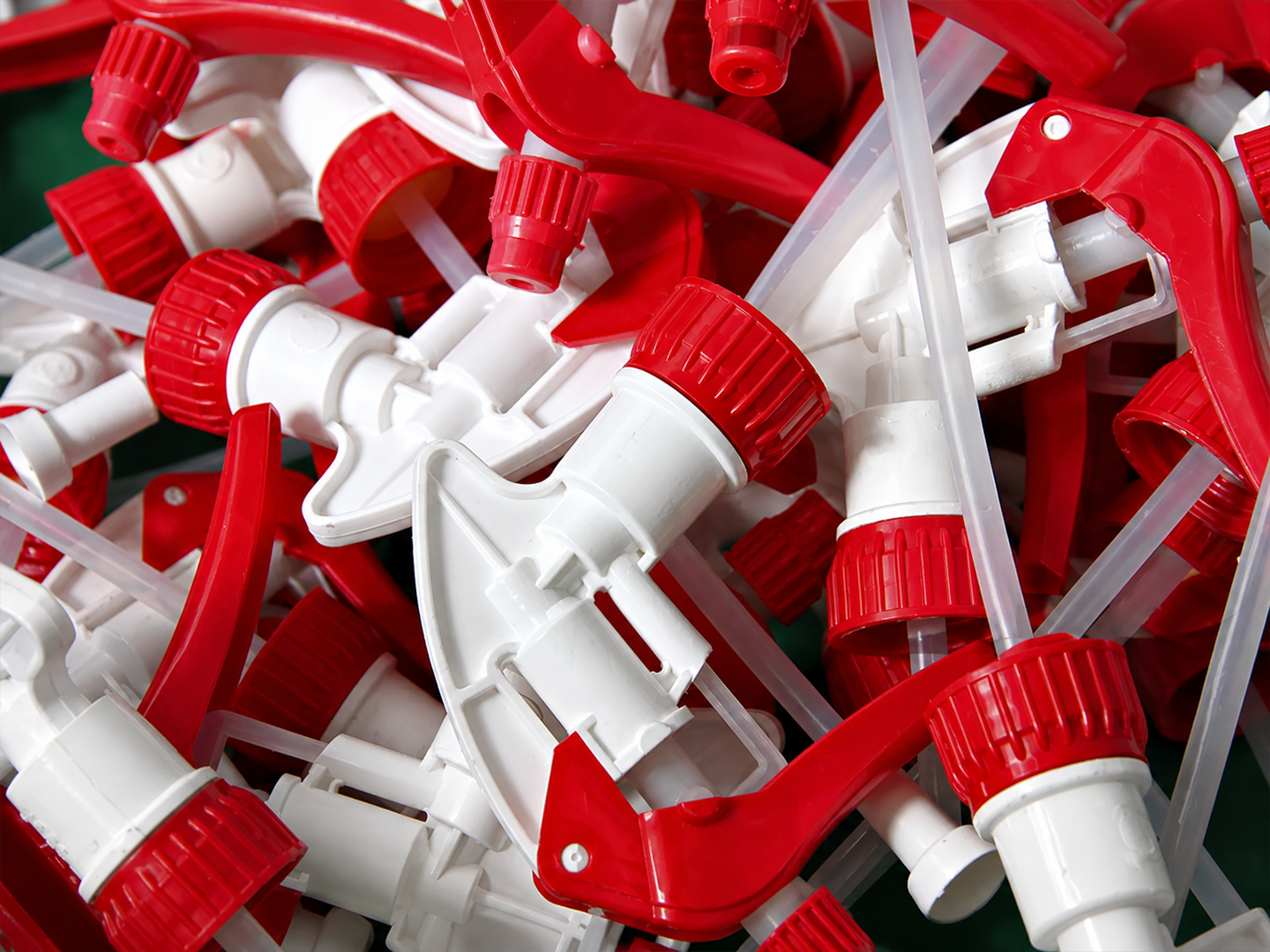
A typical trigger sprayer may include:
- actuator trigger
- pump body
- piston
- spring
- nozzle
- closure
- dip tube
- gasket or sealing components
Each part affects performance.
For example, the nozzle controls how the liquid exits, while the closure and gasket are important for sealing the trigger sprayer to the bottle.
Where Are Trigger Sprayers Used?
Trigger sprayers are particularly common in home care packaging.
Typical applications include glass cleaner, kitchen cleaner, bathroom cleaner, disinfecting products, furniture care products and general household cleaning liquids.
They are also widely used in automotive care, gardening, pet care and selected industrial applications.
The exact sprayer specification should still be selected according to the liquid formulation.
A trigger sprayer used for a mild water-based cleaner may not be the best choice for a more demanding chemical formulation.
Trigger Sprayer vs Fine Mist Sprayer
One of the main differences is dispensing volume.
Fine mist sprayers are usually selected when the product needs a controlled, relatively fine spray.
Trigger sprayers are generally preferred when the user needs to cover a larger surface or dispense more liquid with each action.
For this reason, trigger spray pumps are much more common on 500 ml or 750 ml household cleaning bottles than on small cosmetic bottles.
What Should Buyers Check Before Selecting a Trigger Sprayer?
Bottle neck size should be confirmed first.
Output, spray pattern and nozzle design should also be evaluated according to how the finished product will be used.
The formulation is equally important.
Some liquids require stronger chemical compatibility than standard household products.
Dip tube length, bottle shape and transport conditions should also be tested before mass production.
For a new trigger sprayer project, Sunmart recommends evaluating the bottle, formulation and trigger pump as one packaging system rather than selecting each component independently.